Not Scary

Labels: Barack Obama, Foreign Policy, Foreign Relations
posted by John McAdams at 7:44 PM
0 comments


We are here to provide an independent, rather skeptical view of events at Marquette University. Comments are enabled on most posts, but extended comments are welcome and can be e-mailed to jmcadams2@juno.com. E-mailed comments will be treated like Letters to the Editor. This site has no official connection with Marquette University. Indeed, when University officials find out about it, they will doubtless want it shut down.
Labels: Barack Obama, Foreign Policy, Foreign Relations
posted by John McAdams at 7:44 PM
0 comments
There are two different versions of the story of the end of the Cold War: the Russian version, and the truth. President Barack Obama endorsed the Russian version in Moscow last week.But, one might ask, why not revise history a bit in the interests of getting along? Why be so pro-American?
Speaking to a group of students, our president explained it this way: “The American and Soviet armies were still massed in Europe, trained and ready to fight. The ideological trenches of the last century were roughly in place. Competition in everything from astrophysics to athletics was treated as a zero-sum game. If one person won, then the other person had to lose. And then within a few short years, the world as it was ceased to be. Make no mistake: This change did not come from any one nation. The Cold War reached a conclusion because of the actions of many nations over many years, and because the people of Russia and Eastern Europe stood up and decided that its end would be peaceful.”
The truth, of course, is that the Soviets ran a brutal, authoritarian regime. The KGB killed their opponents or dragged them off to the Gulag. There was no free press, no freedom of speech, no freedom of worship, no freedom of any kind. The basis of the Cold War was not “competition in astrophysics and athletics.” It was a global battle between tyranny and freedom. The Soviet “sphere of influence” was delineated by walls and barbed wire and tanks and secret police to prevent people from escaping. America was an unmatched force for good in the world during the Cold War. The Soviets were not. The Cold War ended not because the Soviets decided it should but because they were no match for the forces of freedom and the commitment of free nations to defend liberty and defeat Communism.
Mr. Obama has become fond of saying, as he did in Russia again last week, that American nuclear disarmament will encourage the North Koreans and the Iranians to give up their nuclear ambitions. Does he really believe that the North Koreans and the Iranians are simply waiting for America to cut funds for missile defense and reduce our strategic nuclear stockpile before they halt their weapons programs?Of course, this is not just “Obama’s way of looking at the world.” It’s the liberals way of looking at the world. It’s the way the average student is taught in the average political science or history class in the average university today.
The White House ought to take a lesson from President Harry Truman. In April, 1950, Truman signed National Security Council report 68 (NSC-68). One of the foundational documents of America’s Cold War strategy, NSC-68 explains the danger of disarming America in the hope of appeasing our enemies. “No people in history,” it reads, “have preserved their freedom who thought that by not being strong enough to protect themselves they might prove inoffensive to their enemies.”
Perhaps Mr. Obama thinks he is making America inoffensive to our enemies. In reality, he is emboldening them and weakening us. America can be disarmed literally -- by cutting our weapons systems and our defensive capabilities -- as Mr. Obama has agreed to do. We can also be disarmed morally by a president who spreads false narratives about our history or who accepts, even if by his silence, our enemies’ lies about us.
Labels: Barack Obama, Cold War, Foreign Policy, Foreign Relations
posted by John McAdams at 8:33 PM
4 comments
EARLY IN HIS PRESIDENCY, Jimmy Carter set about to alter US policy toward the Soviet Union. Six days after his inauguration he sent a letter to Soviet ruler Leonid Brezhnev, hailing the two countries’ “common efforts towards formation of a more peaceful, just, and humane world” and saluting Brezhnev’s supposed “aspiration for strengthening and preserving . . . peace.” In a commencement address at Notre Dame, he declared that Americans had shed “that inordinate fear of communism which once led us to embrace any dictator who joined us in that fear.” In the months that followed, Carter slashed the defense budget, scrapped the B-1 bomber, welcomed the takeover of Nicaragua by a Marxist junta, and launched diplomatic relations with the Castro dictatorship in Cuba.Obama, like Carter, is simply your garden variety liberal. As such, he believes that if we have any enemies it’s our fault that they don’t like us. It couldn’t possibly be that there are evil people in the world (like Communists and radical jihadists) who hate us because of our superior institutions and belief system. Rather, our institutions and belief system are (at best) no better than others, or (more typically) inferior.
Carter’s failure to understand the threat posed by the Soviet Empire had costly consequences for America and the world. Will this pattern now be repeated with Barack Obama and the global threat from radical Islam?
Ever since taking office two weeks ago, Obama has been at pains to proclaim a change in US-Muslim relations. In his inaugural address he invited “the Muslim world” to embark on “a new way forward, based on mutual interest and mutual respect.” Six days later he gave Al-Arabiya, an Arabic-language satellite channel, his first televised interview as president. This week he continued his charm offensive with a friendly letter to the Organization of the Islamic Conference, which represents 57 Muslim governments. He has promised to deliver a major address in an Islamic capital by spring.
The president cannot be faulted for using his bully pulpit to reach out to the world’s Muslims, especially given his Muslim roots and family ties. But running through Obama’s words is a disconcerting theme: that US-Muslim tensions are a mostly recent phenomenon brought on largely by American provincialism, heavy-handedness, and disrespect. Missing is any sense that the United States has long been the target of jihadist fanatics who enjoy widespread support in the Muslim world.
“My job to the Muslim world is to communicate that the Americans are not your enemy,” Obama said, although “we sometimes make mistakes” and “have not been perfect,” and even though “too often the United States starts by dictating” and fails to use “the language of respect.”
Such apologetic pandering is inexcusable. For decades, as commentator Charles Krauthammer noted last week, “America did not just respect Muslims, it bled for them.” To liberate oppressed Muslims in Bosnia, Kosovo, Kuwait, Afghanistan, and Iraq, hundreds of thousands of Americans risked -- and in many cases lost -- their lives.
Even more troubling is Obama’s seeming cluelessness about US-Muslim history.
“The same respect and partnership that America had with the Muslim world as recently as 20 or 30 years ago -- there’s no reason why we can’t restore that,” the president said on Al-Arabiya.
Well, let’s see. Twenty years ago, in 1989, American hostages were being tortured by their Hezbollah captors in Beirut and hundreds of grief-stricken families were in mourning for their loved ones, murdered by Libyan terrorists as they flew home for Christmas on Pan Am Flight 103. Thirty years ago, in 1979, the Ayatollah Khomeini overthrew the Shah of Iran, proclaimed America “the Great Satan” and inspired his acolytes to seize the US embassy and hold scores of Americans hostage for nearly 15 months. That same year Islamist mobs destroyed the US embassies in Pakistan and Libya, and staged anti-American riots in other countries.
The global jihad, like the Cold War, will only end when our enemies lose their will to fight -- or when we do. Let us hope [Obama’s] a quicker study than Jimmy Carter.There is no evidence he will be.
Labels: Barack Obama, Cold War, Foreign Policy, Foreign Relations, Islamofascism, Jimmy Carter
posted by John McAdams at 4:21 PM
1 comments
Labels: 2008 Election, Barak Obama, Foreign Relations, Hillary Clinton
posted by John McAdams at 2:58 PM
0 comments

Labels: Democrats, Foreign Relations, Iraq War
posted by John McAdams at 1:46 AM
0 comments
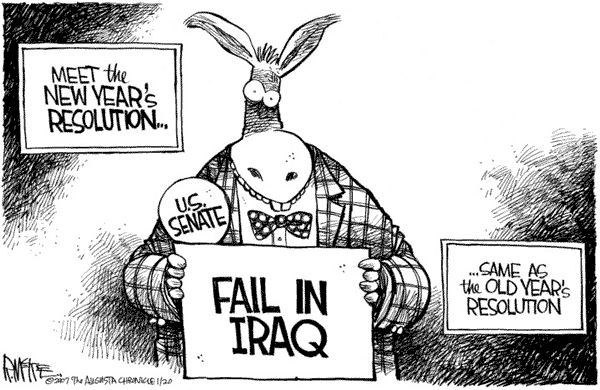
Labels: Democrats, Foreign Relations, Iraq War, Partisanship
posted by John McAdams at 12:17 AM
0 comments

Useful Links
Right Wisconsin — Coverage of Wisconsin news and politics from a conservative perspective.
The Louis Joliet Society — An Alumni Association trying to get Marquette to live up to its claims to be “Catholic.”
Marquette Tribune — Marquette's own junior version of the mainstream media.
Marquette College Republicans — Pretty active of late.
Marquette College Democrats — Just what the name implies, and like the College Republicans, pretty active.
Dad29 — Marquette alum writing mostly on state politics issues.
Marquette University Law School Faculty Blog — Law professors write some of the best blogs in the country, so it's good to see Marquette Law faculty joining that movement.
Shark and Shepherd — Blog from a conservative Law School faculty member.
Mark F. Johnson — Marquette Thomist theologian on various topics.
The Dimming Torch — Liberal Marquette Philosophy professor on politics and other things.
Health Reform Explained — Marquette alum writes about the changes in the health care system.
Kennedy Assassination Home Page — one of this bloggers other obsessions.
Milwaukee Young Republicans — Interesting links and news on events.
Student Blogs
Gay/Straight Alliance of Marquette — Student organization Marquette recognized claiming it was in no way in conflict with Marquette's Catholic mission
Wisconsin Blogs — A Selective List, All Highly Recommended
Atom Feed For This Site
