Marquette Warrior

Monday, March 05, 2018

Jimmy Kimmel: Advocate for Women


Yes, this is a satire site. But this particular article is spot on about the facts (except, perhaps, for “crazed, drunken, slobbering”). Those are only slight exaggerations.

One can get a good idea about the show here, and here.

Labels: , , , , , ,

Sunday, January 14, 2018

So Many Candidates for the Award

GLENN MCCOY © Belleville News-Democrat. Dist. By UNIVERSAL UCLICK. Reprinted with permission. All rights reserved.

Labels: , , , ,

Tuesday, November 21, 2017

Not a Confederate

GLENN MCCOY © Belleville News-Democrat. Dist. By UNIVERSAL UCLICK. Reprinted with permission. All rights reserved.

Labels: , , ,

Monday, April 24, 2017

Bill Clinton’s Advice for O’Reilly

Wednesday, December 30, 2015

The Real War on Women

Sunday, September 21, 2014

Marquette’s Bizarre Training on “Harassment”

Like everybody else at Marquette, we have been required to take an online Title IX training session, addressing sexual violence and sexual (and other) harassment.

We’ll leave the sexual violence issue for another post, and for the moment outline what Marquette has to say about harassment.

On the face of it, the rules aren’t too bad. For unlawful harassment to occur, the following conditions must be met. The action must be:

•Related to a protected category.
•Unwelcome.
•Offensive to a reasonable person in the recipient’s position.
•Severe or pervasive.

That would seem to set the bar reasonably high for a finding of “harassment.”

Unfortunately, the content of the online training module makes hash of any and all the reasonable limitations the announced standards imply.

The Politically Incorrect Office

Consider, for example, a picture of an office, included in the module, in which one has to pick out all the potentially offensive or harassing objects. It’s loaded with them.

(You can click on the image to view a larger version.)

First, one that makes sense: an “adult” magazine is said to be out of bounds because it can contribute to a “hostile working environment.” Fair enough. But it goes downhill from there.

A sign saying “men working” is said to be unacceptable because a Kentucky human rights agency ruled it to be discriminatory, implying the exclusion of women. Might a feminist object to this: of course. Might a reasonable woman? No.

The Kentucky agency should knock off for a day and enjoy a little of the state’s excellent Bourbon.

Also out of bounds is a supposedly risqué photo. What does this outrageous, unacceptable picture show?

A couple at the beach in bathing suits. But the legend notes that “harassment complaints have been filed against workers who display photographs of their spouses in swimsuits.” Somehow, the folks who put this together think that attire that would be acceptable on any beach in the country, and indeed at the pool at Marquette’s Recreation Center, is offensive in an office.

Likewise, a computer screen saver showing a man bare from the waste up (but fully clothed from the waist down) may (it is claimed) create a hostile environment.

And while we are on scanty clothing, we are told that “some courts have required worksites to remove sculptures or painting that contain nudity.” Apparently, some other courts haven’t.

It adds, “what might be appropriate for a museum or an art class may not be acceptable for an office.”

Why not?

We can imagine something truly gross that some deranged professor might choose to display, but if a professor of Greek Culture has a model of “Venus de Milo” or a professor of Renaissance Art a model of Michelangelo’s “David,” no reasonable person would complain.

The sculpture pictured seems bland enough.

And how could a student making an occasional visit to a professor’s office and seeing his wife in a swimsuit or a classic piece of sculpture face “severe” or “pervasive” harassment?

Of course, if a conservative Christian student complained about the public display of nude art on a university campus, she would be derided as a narrow-minded prude. But a different standard apparently applies to feminists.

And it’s not the case that feminists are put off by naked genitals. When Marquette’s Gender and Sexuality Resource Center sponsored a program called Femsex, one of the exercises required participants to draw in the Cunt Coloring Book. Yes, that’s exactly what it sounds like.

Other Protected Groups

Of course, the groups who are “protected” (at least in theory) extend beyond women. A sign saying “Over the Hill” is said to “contribute to a hostile work environment on the basis of age.” We are pretty confident that only old guys would ever display such a sign. Can one harass oneself?

And a token nod (more like a head fake) is given to veterans. An anti-war poster is declared unfit because “extreme anti-war postings could contribute to an environment of harassment based on military or veteran status.”


While we like the idea that the doctrine of “harassment” equally covers both politically correct groups and politically incorrect groups, the poster in question is clearly in the area of protected free speech.

Further, on any college campus, military people have doubtless learned to “suck it up” and put up with leftists. So seeking redress is going to be absurdly rare. If they were the sort who whined about every hardship, they would have never joined the military.

Suppose it Isn’t Actually Unwelcome

People working through the module are quizzed: “Jokes welcomed by the recipient are never harassment. True or false?” The answer: “false.”

It is explained: “jokes related to protected categories can still be harassment, even if they don’t offend the recipient.” So you can be harassed without thinking you are being harassed.

Protection for Groups that Aren’t Protected

Finally, behavior that might be tacky, or even gross, is said to be harassing, in spite of not being addressed by Federal law nor directed at any protected category.

For example, we are told that ringtones that involve weapon sounds are “inappropriate.” But people who don’t like loud noises are not a “protected category.” Neither are liberal weenies who don’t like guns. Private employers may have rules about this, but the Federal government does not (yet).


Punishment for Politically Incorrect Speech

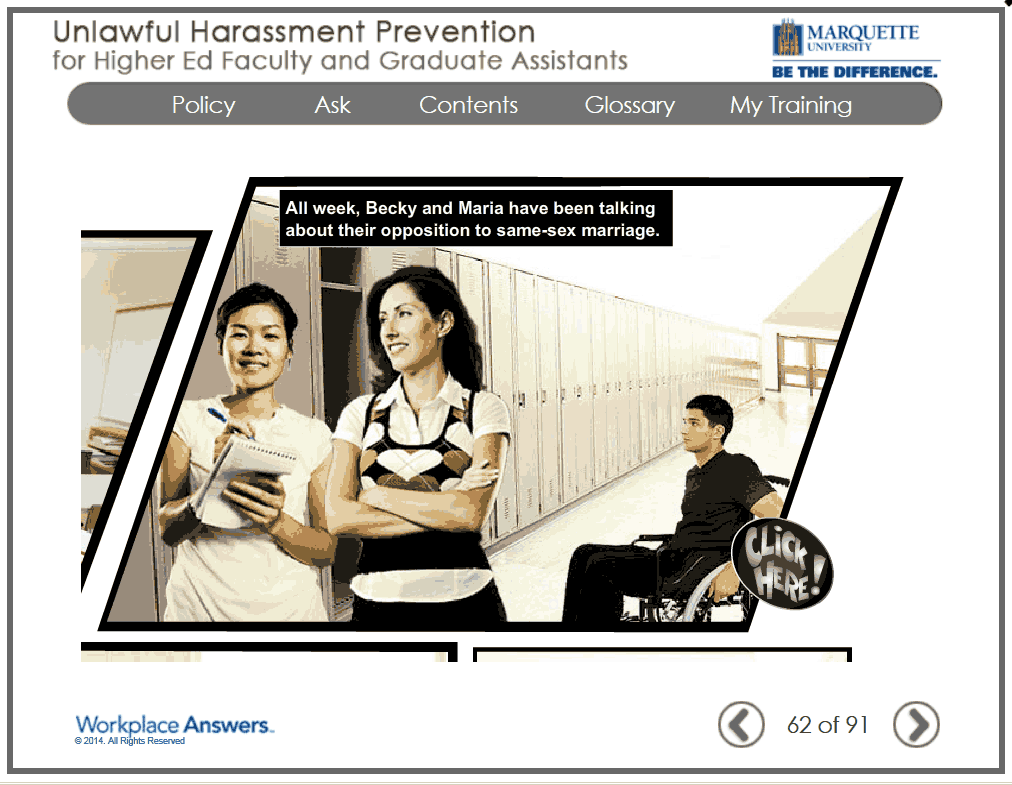
One little sequence in the course involves two women coworkers (Becky and Maria) who discuss their opposition to gay marriage. Another coworker (Hans) overhears them and is offended at their opinions. He reports them to Human Resources.

The conclusion of this little tableau is that Hans did not have to participate in the discussion to be offended by it, and the two female coworkers could be guilty of harassment.

Of course, political liberals are not a protected category, and all Hans was subjected to was hearing opinions that “offended” him. But like so many liberals, he believed that opinions he disliked should be shut up.

Thus Marquette University, in this “training,” has endorsed that view. Notwithstanding that the Catholic Church disapproves of gay marriage, merely endorsing Church teaching in a university setting can be harassment.

Would the two women have been able to complain if Hans had been spouting off about how he favored gay marriage?

Fat chance. Even if the rules claim to protect people in an evenhanded way, everyone knows they don’t.

How Far Do We Take This?

Thus employees of Marquette are clearly warned that expression can be harassment even if it’s:

•Unrelated to a protected category.
•Not Unwelcome.
•Offensive only to an unreasonable person in the recipient’s position.
•Not Severe or pervasive.
•Discussion of a political issue

Since just about anything that somebody might happen to dislike seems to be included under the rubric “harassment,” isn’t the logical endpoint that any objection from anybody is sufficient to shut up any speech or expression?

Thus one is not surprised to find, in the course, the following statement:
Liability Avoidance Tip
It is best not to discuss any of the protected categories at work
So you better not discuss the relations between the sexes (a protected category), anything about race relations (protected category), anything about the status of veterans, anything about getting old (age is a protected category), anything about religion (yet another one) and so on.

In short: stifle.

Conclusion

This, it seems, is the logical endpoint of the bureaucratic mentality. And the bureaucratic mentality dominates the administrative ranks of Marquette University. Like bureaucrats everywhere, they supinely accommodate the demands of special interest groups (feminists, gays and lesbians) and of overbearing government regulators (especially the Obama Justice and Education departments).

They will mouth silly things if they are being said elsewhere in academia. Whatever “initiatives” are fashionable elsewhere, they will mimic.

The current “training” module, for example, is a generic one from an operation called Workplace Answers, which specializes in providing cookie-cutter programs (each one just like the previous one) to places like Marquette. Complete with tacky stock photos.

Bureaucrats don’t much care for free expression, since that creates problems (although they will protect it if failing to creates bigger problems).

What is the Practical Import?

It is not clear how this will play out at Marquette. Perhaps the university is just going through the motions, and reasonable sorts of free expression will prevail.

For example, when some feminist in one of our classes claimed we had sexually harassed her by telling the class that feminists grossly exaggerate the incidence of date rape, the University dismissed the complaint. The fact that we were obviously willing to raise hell at any other outcome might have been the deciding factor.

But when a graduate student in Philosophy posted an innocuous political comment by libertarian humorist Dave Barry on his door, somebody complained to department chair James South. South decided the comment was “patently offensive” and tore it down. The University backed South.

So enclaves of authoritarian intolerance exist at Marquette, and doctrines of “harassment” are a tool they will happily use.

A genuinely Catholic university would be tough on real harassment (and without being bullied by the Federal Government), but would tell the perpetually offended and aggrieved “people are going to disagree with you; live with it.” And it would honestly say so.

But that’s not the Marquette we have.

Labels: , , , , ,

Thursday, May 30, 2013

Obama Administration Mandates Campus Speech Censorship: More

We recently reported on an initiative by the Obama Departments of Justice and Education to require colleges to impose speech codes on campus speech that is in any way “sexual” or references gender.

Basically, it defined as “sexual harassment” any speech that some person on campus finds “offensive.” Established law dictates that speech, to be considered “sexual harassment,” must be offensive to a “reasonable person of the same gender in the same situation.” The new definition means that anything that somebody takes offense at has to be considered “sexual harassment” notwithstanding that no reasonable person would consider it such.

The Federal government has tried to defend this policy, and it doing so has tripped all over itself.

In a form letter sent to people to write the Office for Civil Rights, the claim is made that:
Furthermore, as we have said in the past, OCR’s regulations and policies do not require or prescribe speech, conduct or harassment codes that impair the exercise of rights protected under the First Amendment.
Then the letter tries to walk back the mandate, by explaining that:
Consistent with OCR’s previous, well-established guidance, the May 9 letter explains that “sexual harassment” is unwelcome conduct of a sexual nature but that sexual harassment is not prohibited by Title IX unless it creates a “hostile environment” — that is, unless the harassment is sufficiently severe, pervasive, or persistent such that it denies or limits the student’s ability to participate in or benefit from the school’s program.
Note that “conduct” includes “verbal conduct” (speech).

And of course, what constitutes a “hostile environment” is entirely a matter of a student’s subjective response to speech he or she does not like.

Back in December, 2011, we were charged with “sexual harassment” by some prissy little feminist in our introductory American Government class because we debunked bogus rape statistics that feminist professors and activists are always touting.

She apparently felt the “environment” was “hostile” because she heard views expressed that were out of sync with her feminist worldview.

The explanation of the policy by the Office for Civil Rights actually makes clear that purely subjective offense is something that universities ought to punish:
Students will be allowed to bring complaints when they have been subjected to unwelcome sexual conduct, and the University will evaluate whether that harassment has created a hostile environment. Making this determination requires, as it has in the past, the University to examine both whether the conduct is objectively offensive and its subjective impact on an individual.
So the “subjective impact” on the individual is sufficient for a finding of “sexual harassment.” Thus students who are intolerant of speech with which they disagree, and feel the speech is “hostile” have a right to have the university punish the speaker.

Marquette’s Non-Response

We queried Chris Miller, Vice President for Student Affairs, about this. He is out of the country, and gave us only a brief reply:
You are correct; we have no formal correspondence on it yet however I am in discussion with General Counsel on the matter. Let us try to connect upon my return.
It would be nice to believe that Marquette (and lots of other universities) would challenge this is court. There is not a snowball’s chance in hell of that happening.

In the first place, there are a large number of administrators (largely in offices that have “diversity” in their names) and quite a large number of faculty who very much like the idea of silencing people who say politically incorrect things about sex and gender. To come out against these rules would inflame them, and start them declaring that Marquette is “soft on sexual harassment.”

Further, as the current scandals surrounding the IRS show, Federal bureaucrats (and especially the “civil rights” enforcers) are liberal, capable of being very vindictive, and capable of causing huge trouble for anybody whom they dislike.

So these rules (like the absurd “Dear Colleague” letter about sexual assault) will probably remain in place, at least until they victimize some student, faculty member or staff member who is defiant enough to challenge them in court.

It’s important to remember that these rules will never be enforced in a neutral and consistent way. They will only be used to punish speech offensive to the politically correct activists who dominate most college campuses.

The Foundation for Individual Rights in Education notes, for example, that “The Vagina Monologues” could be outlawed for its lewd sexual content. That will never happen. “The Vagina Monologues” is an expression of politically correct feminism, and the socially conservative students who might object quickly learn that, on a modern college campus, they are to shut up and take what is imposed on them.

Likewise, we are very unlikely to ever be harmed by this rule, because (as Provost John Pauly learned the hard way) we can’t be harassed or bullied into silence.

A more likely outcome is that students will learn that any statements or expressions of opinion to which the campus feminists or the campus gay lobby object are voiced only at great personal risk.

And that, of course, would create the exact kind of campus that liberals and leftists want.

Labels: , , , , , ,

Friday, May 10, 2013

Obama Administration Mandates Campus Speech Censorship

From the Foundation for Individual Rights in Education:
WASHINGTON, May 10, 2013—In a shocking affront to the United States Constitution, the U.S. Departments of Justice and Education have joined together to mandate that virtually every college and university in the United States establish unconstitutional speech codes that violate the First Amendment and decades of legal precedent.

“I am appalled by this attack on free speech on campus from our own government,” said Greg Lukianoff, president of the Foundation for Individual Rights in Education (FIRE), which has been leading the fight against unconstitutional speech codes on America’s college campuses since its founding in 1999. “In 2011, the Department of Education took a hatchet to due process protections for students accused of sexual misconduct. Now the Department of Education has enlisted the help of the Department of Justice to mandate campus speech codes so broad that virtually every student will regularly violate them. The DOE and DOJ are ignoring decades of legal decisions, the Constitution, and common sense, and it is time for colleges and the public to push back.”

In a letter sent yesterday to the University of Montana that explicitly states that it is intended as “a blueprint for colleges and universities throughout the country,” the Departments of Justice and Education have mandated a breathtakingly broad definition of sexual harassment that makes virtually every student in the United States a harasser while ignoring the First Amendment. The mandate applies to every college receiving federal funding—virtually every American institution of higher education nationwide, public or private.

The letter states that “sexual harassment should be more broadly defined as ‘any unwelcome conduct of a sexual nature’” including “verbal conduct” (that is, speech). It then explicitly states that allegedly harassing expression need not even be offensive to an “objectively reasonable person of the same gender in the same situation” — if the listener takes offense to sexually related speech for any reason, no matter how irrationally or unreasonably, the speaker may be punished.

This result directly contradicts previous Department of Education guidance on sexual harassment. In 2003, the Department of Education’s Office for Civil Rights (OCR) stated that harassment “must include something beyond the mere expression of views, words, symbols or thoughts that some person finds offensive.” Further, the letter made clear that “OCR’s standards require that the conduct be evaluated from the perspective of a reasonable person in the alleged victim’s position, considering all the circumstances, including the alleged victim’s age.”

Among the forms of expression now punishable on America’s campuses by order of the federal government are:
  • Any expression related to sexual topics that offends any person. This leaves a wide range of expressive activity—a campus performance of “The Vagina Monologues,” a presentation on safe sex practices, a debate about sexual morality, a discussion of gay marriage, or a classroom lecture on Vladimir Nabokov’s Lolita — subject to discipline.
  • Any sexually themed joke overheard by any person who finds that joke offensive for any reason.
  • Any request for dates or any flirtation that is not welcomed by the recipient of such a request or flirtation.
There is likely no student on any campus anywhere who is not guilty of at least one of these “offenses.” Any attempt to enforce this rule evenhandedly and comprehensively will be impossible.
That, of course, is the main point. When a vast array of speech is illegal, and only a small proportion of potentially “offensive” speech is punished, what will be punished is unpopular speech.

Thus, “The Vagina Monologues” is absolutely safe. Discussion of “safe sex” practices will always be protected. But a Christian ethical critique of homosexual sex will be punished. Criticism of feminism will be punished. Politically incorrect speech will be punished, but politically correct speech, no matter how objectively offensive, will be allowed.
“The federal government has put colleges and universities in an impossible position with this mandate,” said Lukianoff. “With this unwise and unconstitutional decision, the DOJ and DOE have doomed American campuses to years of confusion and expensive lawsuits, while students’ fundamental rights twist in the wind.”

“The Departments of Education and Justice are out of control,” continued Lukianoff. “Banning everyday speech on campus? Eliminating fundamental due process protections? Ignoring its own previous statements? They even misquoted the Supreme Court. This cannot be allowed to continue. FIRE will use all of its resources to oppose this menace to our constitutional freedoms and to free speech and academic freedom on campus.”
It remains to be seen, of course, whether this mandate will survive a court challenge. If federal judges hue to precedent, it certainly will not.

But it is questionable how much longer the federal judiciary will protect free speech when liberal elites are more and more wanting speech they dislike censored.

Labels: , , , ,

Thursday, May 15, 2008

Mainstream Media Puff Bogus Data on “Street Harassment” of Women

Via The Word Warrior, a Marquette feminist blog that deserves credit for good reporting on this issue.

It started with the following story reported by CNN.
(LifeWire) -- When Holly Kearl was researching her master’s thesis on street harassment last winter, she was pleasantly surprised that lewd remarks were few and far between. Then spring rolled around.

“Suddenly, it was April, and I was getting yelled at everywhere by men in cars,” said Kearl, who has since completed a degree in women’s studies and public policy from George Washington University.

As part of her research, Kearl conducted an anonymous, informal e-mail survey of 225 women on the subject. She found that 98 percent of respondents experienced some form of street harassment at least a few times, and about 30 percent reported being harassed on a regular basis.

“For me, anyone who interrupts my personal space to objectify me or make me feel uncomfortable or threatened is harassing me,” she says.
The CNN article admits that some women like the attention, which in the more moderate forms simply says “hey, you’re attractive.”

But then it resumes the feminist blather.
But Kimberly Fairchild, 29, an assistant professor of psychology at Manhattan College in New York, says catcalling can take a larger emotional toll than many women realize.

“There seems to be some evidence that it increases self-objectification,” said Fairchild, who surveyed 550 women both online and at Rutgers University in 2006 and 2007. The women -- who ranged in age from 15 to 64 in the international online component and from 18 to 24 in the Rutgers survey of women from central New Jersey -- were asked about their experiences with street harassment.

Catcalling “encourages women to look at themselves as body parts instead of as full, whole, intelligent human beings” and can cause women to fear for their safety, Fairchild says.

“When a man catcalls you, you don’t know if it will end at that point or if it could escalate to assault,” she added.
The problem, which the CNN story failed to mention, is that the sample of women that produced the “98 percent” figure was absurdly skewed.

The author, Holly Kearl, left a comment on The Word Warrior explaining the problem.
“My survey wasn’t meant to be representative of the larger population. I specifically targeted people I thought would be feminists and thereby might know about anti-street harassment websites like the HollaBacks. That was more what my thesis focused on - how were people responding to and combating street harassment, and did they use these websites? I sent the survey to women’s studies listservs and other feminist groups, so I knew the data was skewed and stated that in my thesis when I talked about the data from my survey. The survey was just one component of how I gathered data. Most of my data came from reading 706 postings on 6 anti-street harassment websites which offered me voluntarily given, first-hand accounts of how people had been harassed, how they reacted, and how they used the websites. In the survey, asking people if they had been harassed was a side question to the ones I was more interested in - how did people respond and what did they think of the hollaback websites . . . and the information about how many people had been harassed warranted two sentences in my 129 page thesis…”

“It’s been hard having the large scope of my thesis reduced to a few sentences put in a context not of my choosing with a headline and photo I would never have chosen either.”
The photo most certainly was a bit salacious.

Not that there’s anything wrong with that.

But the fundamental, indeed fatal, problem is that Kearl sought a sample of feminists, who would be expected to see this issue through the feminist lens of victimization and aggrievement.

Further, there was a massive amount of self-selection into her sample, since it was heavily drawn from women who frequented feminist websites dealing with the issue.

Implying that her sample in any way generalizes to all women was absurd.

There is no doubt that feminists (like all academics who are essentially activists, and not dispassionate scholars) have trafficked in bogus statistics -- most notably on the incidence of date rape.

But in this case, at least, Kearl and The Word Warrior deserve some credit for trying to keep the record straight.

Labels: , , ,