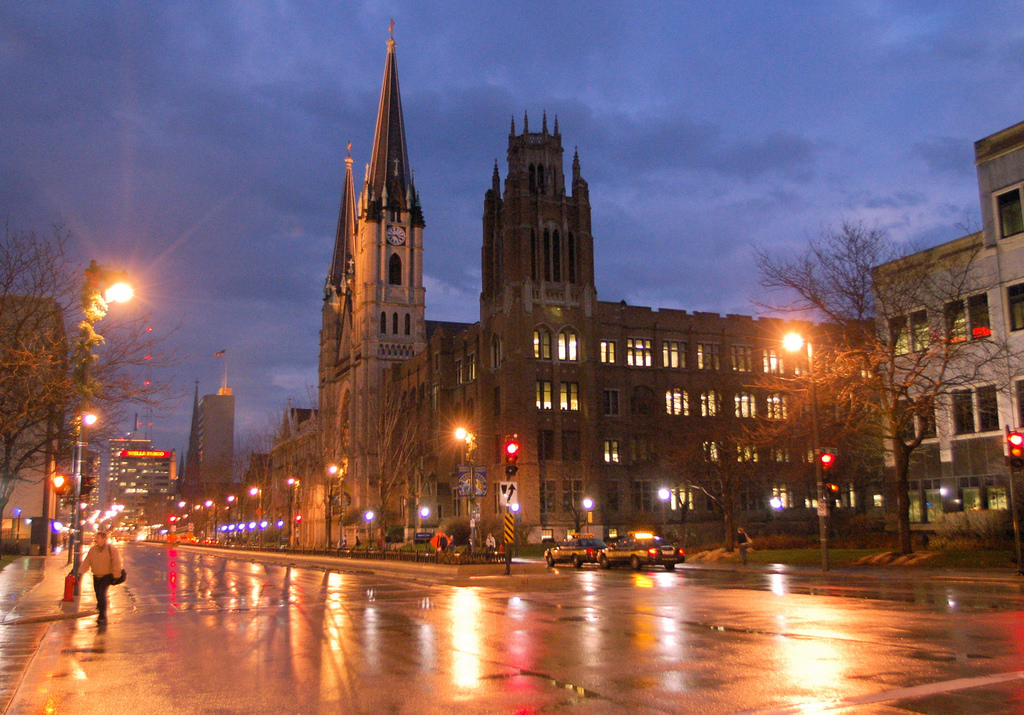
Rick Esenberg: Facts and Implications of Our Legal Case
Labels: Academic Freedom, Daniel Kelly, Federalist Society, John McAdams, Marquette University, Rick Esenberg, Warrior Blogger, Wisconsin Institute for Law and Liberty, Wisconsin Supreme Court
We are here to provide an independent, rather skeptical view of events at Marquette University. Comments are enabled on most posts, but extended comments are welcome and can be e-mailed to jmcadams2@juno.com. E-mailed comments will be treated like Letters to the Editor. This site has no official connection with Marquette University. Indeed, when University officials find out about it, they will doubtless want it shut down.
Labels: Academic Freedom, Daniel Kelly, Federalist Society, John McAdams, Marquette University, Rick Esenberg, Warrior Blogger, Wisconsin Institute for Law and Liberty, Wisconsin Supreme Court
¶42 Under any reasonable standard of impartiality, Dr. Turner would be disqualified. She publicly inserted herself into the dispute and expressed a personal interest in its outcome. And she did not just express her opinions on these matters in passing—she committed herself to them in writing. Having done so, she could not decide the FHC proceedings in favor of Dr. McAdams without contradicting what she had already said to the entire Marquette University campus. These are not anonymous members of the public to whom she would be admitting that her initial convictions were mistaken. They are her professional colleagues and students. The natural human impulse to resist acknowledging a mistake, especially in light of the audience to whom she would be making the acknowledgement, is sufficiently powerful to affect Dr. Turner’s consideration of the dispute. If an arbitrator evidenced this level of bias, we would set aside the resulting award. The FHC’s composition was unacceptably compromised by Dr. Turner’s bias.But more basic was the faulty logic the FHC (and Marquette) used:
¶72 The defects inherent in the University’s alternative analytical structure, however, represent just one of two problems with its assessment. The second is that the University conducted the analysis backwards. With the benefit of hindsight, the University reverse-engineered its conclusion that Dr. McAdams is a plainly unfit professor because of unknown third parties’ reactions to his blog post. The blog post caused “harm,” the University said, in the form of critical, sometimes vile, sometimes violently-worded, responses sent to Instructor Abbate after the story had received national attention. Its “unfitness” analysis proceeded as follows: Instructor Abbate suffered harm because she received offensive communications from third parties; the communications were prompted by Dr. McAdams’ blog post (directly or indirectly); Dr. McAdams has a responsibility not to harm his students; a professor is unfit to serve if he violates his responsibilities to the University’s students. Quod erat demonstrandum. But the University can reach this conclusion only because its analysis traveled in reverse. So quod non erat demonstrandum.Note that it sounds nice to say “professors should always be accurate.” But if any inaccuracy — even a trivial one — can be used as an excuse to fire a troublesome professor, academic freedom doesn’t mean much. Further, what is “accurate” is often a matter of opinion. Can a professor who expresses skepticism about man-made, catastrophic global warming be fired for being “inaccurate?” What about a professor who says that Donald Trump would not have been elected without the interference of the Russians?
¶73 Performing the analysis in the correct direction leads to the unavoidable conclusion that the blog post has nothing relevant to say about Dr. McAdams’ fitness as a professor. The University’s end point is where we start—that is, we consider first whether the challenged extramural comment, on its face, violated Dr. McAdams’ “responsibilities to . . . [the University’s] students.” Although Instructor Abbate was functioning as a University instructor, we will consider only her status as a student for purposes of this analysis. The University identified several aspects of the blog post that it believes were problematic. For instance, it says Dr. McAdams relied on improperly obtained information (the surreptitious recording of the conversation between Instructor Abbate and the student); he identified Instructor Abbate by name; he linked to her contact information; he drafted the post in a way that would subject Instructor Abbate to public contempt; and the post contains factual errors.
¶74 The undisputed facts show that none of the aspects of the blog post about which the University is concerned could have violated Dr. McAdams’ responsibility to Instructor Abbate. The FHC’s Report acknowledged that there is no prohibition against naming a student in a blog post. Nor is it improper for a faculty member to link to a student’s personal webpage, even when that webpage lists the student’s contact information. The Report acknowledged this is still true even when the blog post is critical of the student. Nor do blogging faculty members have a general obligation to ensure every statement they make in a post is accurate.
¶76 Finally, there is the University’s assertion that Dr. McAdams drafted the blog post in such a way that it would subject Instructor Abbate to public contempt. The blog post is certainly critical of her, so one could reasonably foresee that it would engender critical responses. We do not understand the University to argue that an extramural comment that causes such responses is beyond the pale—an extraordinarily unusual argument for an educational institution to make—so we perceive its concern to be about the responses that go beyond the realm of reasonable criticism. But the University did not identify any aspect of what Dr. McAdams actually wrote to support its charge. Instead, it used third-party responses to the blog post as a proxy for its allegedly contempt-inducing nature. Here again, the University demonstrates that reverse-engineering a conclusion is not the most reliable method of conducting an analysis. In this instance, the University caught itself up in the “post hoc ergo propter hoc” fallacy. Just because vile commentary followed the blog post does not mean the blog post instigated or invited the vileness. The University must identify which part of the blog post is supposed to have been responsible for eliciting the offensive remarks. It did not even attempt to do so. Our review of the blog post reveals that it makes no ad hominem attack on Instructor Abbate, nor does it invite readers to be uncivil to her, either explicitly or implicitly. Because the University’s logical fallacy represents the entirety of its assertion that Dr. McAdams wrote the blog post to subject Instructor Abbate to contempt, we must reject it.The Supreme Court decision was a humiliating defeat for Marquette generally, and specifically for the Faculty Hearing Committee and President Michael Lovell.
“Dismissal will not be used to restrain faculty members in their exercise of academic freedom or other rights guaranteed them by the United States Constitution.”What sort of arrogance on the part of Michael Lovell and mendacity on the part of the Faculty Hearing Committee made them think they could trample on that legally binding promise?
Labels: Academic Freedom, Faculty Hearing Committee, John McAdams, Lynn Turner, McAdams v. Marquette, Michael Lovell, Wisconsin Supreme Court
The University denies Dr. McAdams’ right to litigate his breach of contract claim in our courts. Instead, it says, we must defer to its procedure for suspending and dismissing tenured faculty members. It claims we may not question its decision so long as it did not abuse its discretion, infringe any constitutional rights, act in bad faith, or engage in fraud.Why did the court refuse to defer to Marquette? For several reasons.
¶2 The University is mistaken. We may question, and we do not defer. The University’s internal dispute resolution process is not a substitute for Dr. McAdams’ right to sue in our courts. The University’s internal process may serve it well as an informal means of resolving disputes, but as a replacement for litigation in our courts, it is structurally flawed.
¶3 The undisputed facts show that the University breached its contract with Dr. McAdams when it suspended him for engaging in activity protected by the contract’s guarantee of academic freedom. Therefore, we reverse the circuit court and remand this cause with instructions to enter judgment in favor of Dr. McAdams, conduct further proceedings to determine damages (which shall include back pay), and order the University to immediately reinstate Dr. McAdams with unimpaired rank, tenure, compensation, and benefits, as required by § 307.09 of the University’s Statutes on Faculty Appointment, Promotion and Tenure (the “Faculty Statutes”).
¶25 The most obvious reason we will not defer to the University is simply that the parties never agreed that its internal Discipline Procedure would either replace or limit the adjudication of their contract dispute in our courts. They certainly could have agreed to an extra-judicial resolution of their contract dispute. This is a common feature in society today and is accomplished most often through an arbitration agreement. [...]
¶26 Our exhaustive review of the Faculty Statutes reveals no indication that the University and Dr. McAdams agreed the Discipline Procedure would supplant the courts or limit their review of a contractual dispute. Two of the Faculty Statutes acknowledge Dr. McAdams’ right to seek judicial adjudication of his claims. The first describes the right negatively by demarcating a period of time in which the parties agree not to litigate. . . .
¶27 The Faculty Statutes also contain an explicit, positively-stated recognition of Dr. McAdams’ right to litigate. . . .
This provision unambiguously recognizes that the University’s suspension and dismissal decisions are subject to litigation in our courts. It was with good reason that the University conceded, during oral arguments, that it had no express agreement with Dr. McAdams that the Discipline Procedure would preclude his right to litigate his cause here.
¶28 The University and Dr. McAdams could have agreed that the court would defer to the Report and Discipline Letter in the same way we defer to arbitration decisions. They could have done that, but they did not. They did the opposite: The University agreed it would defer to the court’s adjudication of Dr. McAdams’ right to reinstatement.
¶49 As a matter of process, therefore, there is a hard break between the Discipline Procedure and the actual decision to suspend Dr. McAdams. While the dispute was in the hands of a body that had no authority to resolve it (the FHC), the case was subject to the detailed Discipline Procedure. However, once it reached the actual decision-maker (President Lovell), there were no procedures to govern the decision-making process. The Discipline Procedure does not tell President Lovell how to reach his decision, and nothing in the record before us suggests the president’s decision must have any relationship to the FHC’s work. As far as the Faculty Statutes and Faculty Handbook are concerned, the president may proceed as if the Report said nothing but that the FHC had completed the Discipline Procedure. Consequently, the efficient cause of Dr. McAdams’ suspension without pay was the Discipline Letter, and there is no evidence that it resulted from any prescribed procedure at all. It was the product of President Lovell’s exercise of unfettered discretion. Even if we were inclined to defer to the authoritative resolution of Dr. McAdams’ case (as opposed to the FHC’s Report), there is quite literally nothing to which we could apply an arbitration-style review.
¶140 The majority errs in conducting only half of the academic freedom analysis. It fails to recognize, much less analyze, the academic freedom of Marquette as a private, Catholic, Jesuit university. As a result, it dilutes a private educational institution’s autonomy to make its own academic decisions in fulfillment of its unique mission.This, of course, is complete nonsense. The “group of tenured faculty members” (the Faculty Hearing Committee) does not “live by academic freedom.” Most of them have nothing much controversial to say, or if they do, they express the leftist opinions approved by most of the faculty (and thus safe from faculty-centered disciplinary procedures).
¶141 Further, the majority compounds this error by rendering meaningless a key component of shared governance, reducing the faculty’s bargained-for role in reviewing dismissal for cause to “nothing” or a mere “distraction.” In disregarding the faculty hearing committee’s expertise and unanimous recommendation, it throws aside a process that is mutually agreed upon and time-honored. Apparently, the majority thinks it is in a better position to address concerns of academic freedom than a group of tenured faculty members who live the doctrine every day.
¶58 The dissent says we should nonetheless defer to the University, and that failing to do so “renders meaningless a key part of shared governance, reducing the faculty’s role in this decisionmaking to nothing.” Dissent, ¶173. The author, however, does not identify the key part of shared governance we have rendered meaningless, nor could she. The faculty’s authority to share in the University’s governance comes from the Faculty Statutes and Faculty Handbook, not some formless notion of what shared governance ought to be. We have taken these authorities as they are, and scrupulously examined their provisions. The faculty’s role is what our opinion says it is because that is the arrangement upon which the University and its faculty members have agreed. It is not our place to rewrite their management structure to give the faculty a more muscular role in the University’s affairs than they currently have. Because the dissent identified no Faculty Statute or Faculty Handbook provision that we have overlooked or misconstrued, we decline the implicit invitation to disregard what these authorities so plainly say.Marquette’s case was so poor we are left wondering “what were they thinking?” Quite likely, when they began their jihad against us, they expected we would just take some money and walk away. But when they found that wasn’t so, why did they not back off?
Labels: Academic Freedom, Ann Walsh Bradley, John McAdams, Marquette University, McAdams v. Marquette, Shared Governance, Shirley Abrahamson, Wisconsin Supreme Court
The University posited that educational institutions assume academic freedom is just one value that must be balanced against “other values core to their mission.” Some of those values, it says, include the obligation to "take care not to cause harm, directly or indirectly, to members of the university community,” “to respect the dignity of others and to acknowledge their right to express differing opinions,” to “safeguard[] the conditions for the community to exist,” to “ensur[e] colleagues feel free to explore undeveloped ideas,” and to carry out “the concept of cura personalis,” which involves working and caring “for all aspects of the lives of the members of the institution.” These are worthy aspirations, and they reflect well on the University. But they contain insufficiently certain standards by which a professor’s compliance may be measured. Setting the doctrine of academic freedom adrift amongst these competing values would deprive the doctrine of its instructive power; it would provide faculty members with little to no guidance on what it covers.The Court was doubtless unimpressed with Marquette’s pious rhetoric about “values” in light of the fact that our blog post highlighted an instructor who insulted a student, telling him that his opposition to gay marriage would sound homophobic, would be offensive, and could not be expressed in her class. When he complained to authorities he was blown off, and indeed insulted.
The university has forcefully pushed back against McAdams’s narrative that the key issue is academic freedom. It pressed its case in advertisements in newspapers, including The Wall Street Journal. It set up a web page, complete with a timeline and fact-vs.-myth section. It hired a public-relations firm with a storytelling team.Marquette, in fact, even bought Google ads to lead web surfers to a page that attacks us.
“In terms of our brand and public perception,” Lovell says, “we were taking a beating. We thought it was important to at least try to get the truth out about what we felt our side of the story was.”
It bears repeating: We shouldn’t expect only students of color to respond to racism. I’m asking all of @MarquetteU to join me and share why you #StandAgainstRacism pic.twitter.com/ZzS4nlSxqU— Michael Lovell (@PresLovell) April 30, 2018
Labels: Academic Freedom, Free Speech, John McAdams, Leftist Intolerance, Liberal Intolerance, McAdams v. Marquette, Michael Lovell, Wisconsin Supreme Court

Next, the court considered whether Marquette had “discretionary cause” to suspend McAdams. The court began by citing the relevant contractual provisions, which defined “discretionary cause” as conduct that “clearly and substantially fail to meet the standard of personal and professional excellence which generally characterizes University faculties.”But Cleveland goes on to highlight the fundamental social problems behind this whole incident:
However, as the court highlighted, the faculty contract expressly stated that discretionary cause will not “be interpreted so as to impair the full and free enjoyment of legitimate personal or academic freedoms of thought, doctrine, discourse, association, advocacy, or action.” The court then methodically considered Marquette’s rationale for suspending McAdams, stressing that it was McAdams’ conduct—and not the response of third parties—that mattered, explaining:
Just because vile commentary followed the blog post does not mean the blog post instigated or invited the vileness. The University must identify which part of the blog post is supposed to have been responsible for eliciting the offensive remarks. It did not even attempt to do so. Our review of the blog post reveals that it makes no ad hominem attack on Instructor Abbate, nor does it invite readers to be uncivil to her, either explicitly or implicitly. Because the University’s logical fallacy represents the entirety of its assertion that Dr. McAdams wrote the blog post to subject Instructor Abbate to contempt, we must reject it.
Further, Marquette’s attempt to hold McAdams responsible for threats meted out by third parties upends academic freedom. It implies a faculty member must self-censor and limit criticism out of a fear that others will respond with threats or even violence. Yet nothing McAdams wrote reeked of an incitement to harassment or violence. The Wisconsin Supreme Court published the entire blog post and a quick read confirms the court’s view that McAdams had not invited the vile emails Abbate received.
Yet Abbate did receive emails that made her fear for her safety. I am not unsympathic to Abbate’s concerns, and few conservative journalists or politicians would be. But McAdams isn’t the problem. The problem is a society that teaches that words spoken in a classroom debate are so offensive that they must be silenced; a society that resorts to doxxing to silence speech instead of countering speech; and a society that views harassment and violence as appropriate responses to “offensive” speech.
This says nothing about McAdams, who criticized Abbate on the merits of her conduct, and everything about the decline of civility facing our country.
Two Wisconsin Supreme Court justices dissented from the majority’s decision in favor of McAdams. The dissent merits consideration, not because of the faulty analysis of McAdams’ case, but because of the helpful discussion of academic freedom.Marquette claims the right to hire “for mission.” This means Marquette has the right to hire people loyal to Catholic teaching, and even to prefer practicing Catholics.
Many wrongly believe academic freedom rests solely with faculty members, but the dissent, authored by Justice Ann Walsh Bradley, highlights that academic freedom includes two components: academic freedom of the faculty and academic freedom of the institution. Marquette’s “institutional academic freedom is inclusive of four ‘essential freedoms’: ‘to determine for itself on academic grounds who may teach, what may be taught, how it shall be taught, and who may be admitted to study.’“
As a Catholic, Jesuit institution, Marquette possesses the right to exercise these four “essential freedoms” consistent with its guiding values, described by the dissent as the “holistic development of students” and a “commitment to the Jesuit tradition and Catholic social teaching.” Marquette could, then, have hired only faculty members willing to instruct students consistent with the university’s professed Catholic mission, in which case it could fire faculty members who do not live up to that commitment.
But it didn’t, as is obvious from the university’s decision to employ an instructor who, in contradiction of clear church teaching, taught students that “everybody agrees” on “gay rights.” Marquette instead promised faculty members the right to individual academic freedom, without regard to the university’s Catholic character. By committing itself “not to impair the full and free enjoyment of legitimate personal or academic freedoms,” Marquette forfeited its right to rein in McAdams’ speech as purportedly contrary to the university’s mission.
In its news release, Marquette hinted that it intends to reassert its institutional right to academic freedom, explaining that “in light of today’s decision, Marquette will work with its faculty to re-examine its policies, with the goal of providing every assurance possible that this never happens again” (emphasis added). Of course, by “this,” Marquette means public criticism of an instructor. If only the Jesuit university meant assuring faculty members do not silence student speech, especially speech defending Catholic teaching against a professor’s heresy. That is something I could get behind.
Labels: Catholic Mission, Margot Cleveland, Marquette University, McAdams v. Marquette, The Federalist, Wisconsin Supreme Court

Labels: Academic Freedom, John McAdams, McAdams v. Marquette, WILL, Wisconsin Institute for Law and Liberty, Wisconsin Supreme Court
The student complained to Dr. Susanne Foster in the College of Arts & Sciences, and was sent to the Philosophy Department where he spoke with then-chair Dr. Nancy Snow and Dr. Sebastian Luft. Neither Dr. Snow nor Dr. Luft took any action on behalf of the student. In fact, Dr. Snow referred to him as an “insolent little twerp” in a communication with the College of Arts & Sciences. What Dr. Snow did do was communicate immediately with Ms. Abbate to tell her, in essence, that they had her back. Dr. Snow reported to Ms. Abbate that she told the student that he “needed to change his attitude” and that she would be “monitoring” the situation. Dr. Snow told Ms. Abbate to let her know if the student did anything that Ms. Abbate found objectionable. Ms. Abbate thanked Dr. Snow and said that hopefully the student learned that “oppressive discourse is not acceptable.”Abbate was, in other words, not some green, inexperienced instructor who needed some tips on how to deescalate a confrontation. She was a politically correct leftist whose suppression of politically incorrect ideas reflected the views of her faculty mentors, and of the leadership of the Marquette Philosophy Department.
Labels: Cheryl Abbate, Marquette University, Marquette v. McAdams, Philosophy Department, Ralph Weber, Rick Esenberg, Wisconsin Supreme Court
Labels: Academic Freedom, Cheryl Abbate, Free Speech, Marquette v. McAdams, Rick Esenberg, Wisconsin Institute for Law and Liberty, Wisconsin Supreme Court
Tomorrow is Election Day in Wisconsin, and there is a very important race for the Wisconsin Supreme Court on the ballot.
I want to take a moment to encourage you to vote for Justice David Prosser for the Wisconsin Supreme Court tomorrow, Tuesday, April 5. Justice Prosser has served the people of Wisconsin for his entire career — as a prosecutor, a legislator, and for the last twelve years, a Supreme Court justice. He is an independent, fair justice — we don’t agree in every single case, but we share a common commitment to deciding cases as “judicial conservatives” — following the rule of law, deferring to the political branches as appropriate, and sticking to the text of the laws at issue. I also know him personally as a friend and mentor, and appreciate his lifetime of honorable service to our state.
Thanks for your consideration; however you decide in this race, please make sure to take a few minutes tomorrow to do your civic duty and vote.
Labels: David Prosser, Election, Wisconsin Supreme Court
Law School hosting forum with Michael GablemanWe probably won’t be able to live blog he event.
State Supreme Court candidate Michael Gableman is the next guest for “On the Issues with Mike Gousha” at the Law School. Gableman will discuss his judicial philosophy and whether judicial campaigns should look like other political campaigns on Tuesday, Jan. 15, from 12:15 p.m. to 1:15 p.m. in room 325 of Sensenbrenner Hall, 1103 W. Wisconsin Ave.
Gableman, a Burnett County Circuit Court judge, is running against Justice Louis Butler in the upcoming election. He is a former district attorney, administrative law judge, adjunct professor of law, deputy corporation counsel, private practice attorney and teacher. Justice Butler appeared at the Law School in November; a podcast of his appearance is available online.
Visit the Law School Web site for more information and to register.
Labels: Marquette Law School, Michael Gableman, Wisconsin Politics, Wisconsin Supreme Court
Arrogance Over DeferenceThe election is going to be a real donnybrook, which Butler being supported by a range of interests who like his legislation.
Justice Butler often substitutes his own judgment for that of another institution when that institution is entitled by law to deference.Failure to defer to the trial court – Love, Armstrong, Dubose, Shomberg
Failure to defer to the legislature – Trujillo, Kohn, Diana P., Max G.W., Kolupar
Failure to defer to the U.S. Supreme Court – Knapp, Dubose, McGrew
Failure to defer to a government agency – Johnson, Meyers, Szleszinski
Overturning Precedent
Justice Butler often fails to show appropriate respect for the Court’s decisions in past cases. Trujillo, Knapp, Dairyland, Bartholomew
Acting Like a Legislator
Justice Butler often fails to respect the constitutional and practical limitations of the judicial office.
Extensive citations to non-legal authorities – Dubose, Shomberg, Thomas
Moral outrage substituted for sound legal reasoning – Thomas, Jones
Labels: Judicial Activism, Louis Butler, Wisconsin Politics, Wisconsin Supreme Court
Labels: Annette Ziegler, Campaign Ads, Judicial Activism, Linda Clifford, Political Ads, Supreme Court, Wisconsin Supreme Court
No Prison Time for a Sex Offender?So we ask, as we did in a previous post: do liberals see anything ethically wrong with campaign ads that intentionally try to mislead?
The Greater Wisconsin Committee, a state-wide political action committee funded by labor, education and healthcare PACs, attacked the tough-on-crime image that’s been a staple of Ziegler’s own ads with a spot claiming that Ziegler gave a convicted sex offender a lighter sentence than even his own defense attorney asked. The ad is true only if the sentence is measured strictly by years in prison. The whole story is more complicated.
In December 1998 a jury found Gary Tate guilty of sexually assaulting his step-daughter repeatedly during a three-year period. Ziegler sentenced Tate to 25 years in prison but stayed the sentence, instead giving him a year in county jail and 20 years’ probation conditioned upon Tate successfully completing a treatment program for sexual offenders. At the time, admission of guilt was a requirement of the treatment program.
According to the Milwaukee Journal-Sentinel, Ziegler made this comment at the sentencing:MJ-S: “I want very much to punish the defendant for what he did,” Ziegler said. “I want very much to protect the community.” Equally important is providing treatment “so this never happens to anyone else again,” Ziegler said.Tate filed a motion asking for a new trial, but Ziegler denied it. Tate refused to admit he was guilty, which meant he automatically flunked his sexual-offender treatment. His probation was revoked as a result, and he began serving his 25-year prison sentence.
In November 2002, Tate appealed his probation revocation. The case went to the state Supreme Court. Tate’s lawyers argued that since his sexual-offender treatment required him to incriminate himself and thereby forfeit any possibility of future appeals, the revocation of his parole was unconstitutional. The Supreme Court ruled in Tate’s favor. He was released from prison and is living in Wisconsin, according to the Wisconsin Sex-Offender Registry.
The ad is misleading in implying that Ziegler sentenced Tate to nothing more than a year in county jail. It would have been accurate to say that Tate became a free man just four years after his conviction as a result of Ziegler’s sentence.
Labels: Annette Ziegler, Campaign Ads, Judicial Activism, Linda Clifford, Political Ads, Supreme Court, Wisconsin Supreme Court
West Bend – Linda Clifford’s campaign has been caught lying again. In both a press release and new attack television commercial, the Clifford campaign deliberately attempts to mislead voters.The Clifford campaign has made a big deal of Ziegler’s failure to recuse herself from several cases that involved West Bend Savings and Loan (where her husband sits on the Board of Directors).
Clifford’s campaign claims that nearly 60% of the child sex offenders (1st and 2nd Degree Sexual Assault and Repeated Sexual Assault of a Child) sentenced by Judge Ziegler were given a year in jail or less. However, they include the following cases in their calculation:In eight of the nine remaining cases Clifford cites, Judge Ziegler simply was signing off on the district attorney’s joint agreement.
- 1997CF000270 – The sentence in that case was handed down by Judge Richard Becker, not Judge Ziegler.
- 2001CF000271 – The defendant in this case was sentenced in multiple cases (see 2001CF000359) on March 15, 2002 and was given 25 years in prison by Judge Ziegler for his crimes.
- 2000CF000432 – The defendant in this case was convicted of a misdemeanor and not eligible for prison.
“Linda Clifford should be ashamed of herself for launching these desperate attacks against a judge who is known for her tough sentences of sex predators,” said Sheriff Maury Straub, who is one of the 54 sheriffs endorsing Judge Ziegler. “Linda Clifford has a clear problem with telling the truth and voters are going to reject her dishonest campaign on Tuesday.”
According to the Wisconsin Sentencing Commission, the median prison sentence given for Repeated Sexual Assault of the Same Child (948.025(1)) is 10 years. Judge Ziegler’s median sentence for the same crime is 20 years in prison – twice the statewide number.
Additionally, since 2000, Ziegler has been substituted ten times in child sex offender cases. During that same period of time, the other three judges in Washington County were only substituted for in a cumulative total of four child sex offense cases. That means Judge Ziegler has been substituted on over twice as many times in child sex offender cases as the other three judges combined.
“Judge Ziegler has one of the strongest records in the state when it comes to handing out sentences to child sex offenders,” said District Attorney Todd Martens, who is one of the 43 district attorneys endorsing Judge Ziegler. “Sex offenders actually work hard to get out of her courtroom because they know what her real sentencing record.”
Judge Ziegler is the only judge and only prosecutor running for the Supreme Court. In addition to the bipartisan support of a majority of Wisconsin’s sheriffs and district attorneys, Judge Ziegler has been endorsed by every law enforcement organization that has endorsed in the race.
Labels: Annette Ziegler, Campaign Ads, Judicial Activism, Linda Clifford, Political Ads, Supreme Court, Wisconsin Supreme Court
Labels: Annette Ziegler, Joseph Schuster, Linda Clifford, Marquette Radio, Matt Woleske, Wisconsin Supreme Court
As a justice, I promise:Unfortunately it is legislating from the bench when you believe “civil liberties, constitutional rights, or fundamental freedoms” can mean pretty much what you want them to mean.
- To uphold the rule of law, putting aside personal or political preferences;
- To rely on legal precedent to promote legal stability, but not blindly, respecting the need for the slow evolution of the common law to reflect social, technological, or legislative change; and
- To interpret and uphold legislative enactments to advance legislative intent--UNLESS those enactments violate civil liberties, constitutional rights, or fundamental freedoms or violate other constitutional or statutory provisions.
Then, I would have the courage to strike them down. That’s not activism; that’s not legislating from the bench. [emphasis in original]
Labels: Gay Lobby, Gay Marriage, Linda Clifford, Wisconsin Supreme Court
Take NoteThis is what happens when judges adopt an activist posture. Constitutions cease to matter. Precedents cease to matter. All that comes to matter are the policy preferences of the judges. And Clifford is a liberal, endorsed by all the usual liberal suspects. They must feel -- and they are probably right -- that she will give them the policies they want.
Unreported in today’s article on the Supreme Court debate is a comment by candidate Linda Clifford, who responded to a question saying that the law regarding “school choice” needs “clarification.”
It does? What does that mean?
The Wisconsin Supreme Court in 1998 upheld the constitutionality of the Milwaukee Parental Choice Program. On a 4-2 vote, with Justice Ann Walsh Bradley recusing, the court rejected each and every point raised by lawyers for teacher unions.
In 2002 the United States Supreme Court upheld the constitutionality of the Cleveland voucher program.
There is no benign way to interpret Clifford’s comment. “Clarifying” the 1998 court decision can only suggest an adverse impact on Milwaukee’s program. This would affect not only Milwaukee but parents and families statewide, as some candidates for public office and some sitting officials favor an expansion beyond Milwaukee. While that likely would not occur while Jim Doyle is governor, he won’t be governor forever. However, Linda Clifford, his candidate for the Supreme Court, easily could serve for decades if elected April 3.
After April 3, three of seven Supreme Court justices on the court in 1998 will remain. They are Chief Justice Abrahamson, Justice Patrick Crooks, and Justice Ann Walsh Bradley.
Justice Abrahamson dissented in the 1998 decision. Justice Crooks voted with the majority. For reasons not publicly explained, Justice Bradley recused herself.
New to the court are Justice Butler, a Doyle appointee; Justice Pat Roggensack; and Justice David Prosser.
As an appellate judge, Justice Roggensack authored a lengthy dissent in support of the Milwaukee program’s constitutionality when the case was heard in 1997. Her dissent became the spine of Justice Steinmetz’s 4-2 majority opinion in 1998. So, she clearly is on record, as is Justice Crooks.
Justice Prosser was a member of the Legislature and strong supporter of school choice in the 1990s. He, too, presumably believes the law is constitutional.
So, that is three apparent votes to sustain the principles established in the 1998 Wisconsin and 2002 U.S. Supreme Court case.
Chief Justice Abrahamson is on record that the program is unconstitutional. When I asked Louis Butler his opinion during his candidacy against Diane Sykes, he pointedly declined to answer.
Justice Bradley’s reasons for recusing in 1998 are not known, as is whether she would recuse herself if another case came before the court. Justice Bradley often agrees with Chief Justice Abrahamson.
So, the math is clear. Three apparent votes to sustain prior rulings on choice. Three potential votes not to sustain.
Linda Clifford is seeking the fill the seat of Justice Wilcox, who voted with the majority in 1998. She could provide a fourth vote to “clarify” the school choice law.
I am unaware of Judge Ziegler’s position, though the presumption must be that she would vote to sustain the precedent set by the 1998 and 2002 decisions.
Linda Clifford’s comment is significant beyond the very ominous implications for school choice. If anything has seemed clear in the school choice debate, it is that the law is settled. Yet Clifford is saying otherwise, notwithstanding two court rulings (that happen to reflect the thinking first set down by Justice Roggensack).
What other established precedents does Linda Clifford think need “clarification”?
Does Clifford’s opinion on choice explain the Greater Wisconsin Committee’s issue ad in her behalf? Did WEAC fund that?
These and many related questions now are at the center of this race.
Labels: George Mitchell, Judicial Activism, Linda Clifford, School Choice, Supreme Court, Wisconsin Supreme Court